General Knowledge Quiz Questions: 30 Questions With Answers
Need a dependable set of general knowledge quiz questions? This collection gives you thirty mixed questions, the correct answer, and a short explanation you can use for revision, a classroom warm-up, or a friendly quiz night.
5 subject groups · stable facts · answer explanations
A useful question set balances familiar wins with a few clues that make players think.
THE SHORT ANSWER
How to use these general knowledge quiz questions
Read each question without looking at the answer, make a quick guess, and then check the explanation. The goal is not to protect a perfect score; it is to connect a fact with enough context that you can recognise it again later.
The set is deliberately broad. You will move from planets and plants to history, maps, technology, language, and sport. That mix mirrors the way a general knowledge round is usually written and makes the page useful for solo practice as well as a host who needs a ready answer key.
A SIMPLE ROUTINE
Turn a list into a better practice session
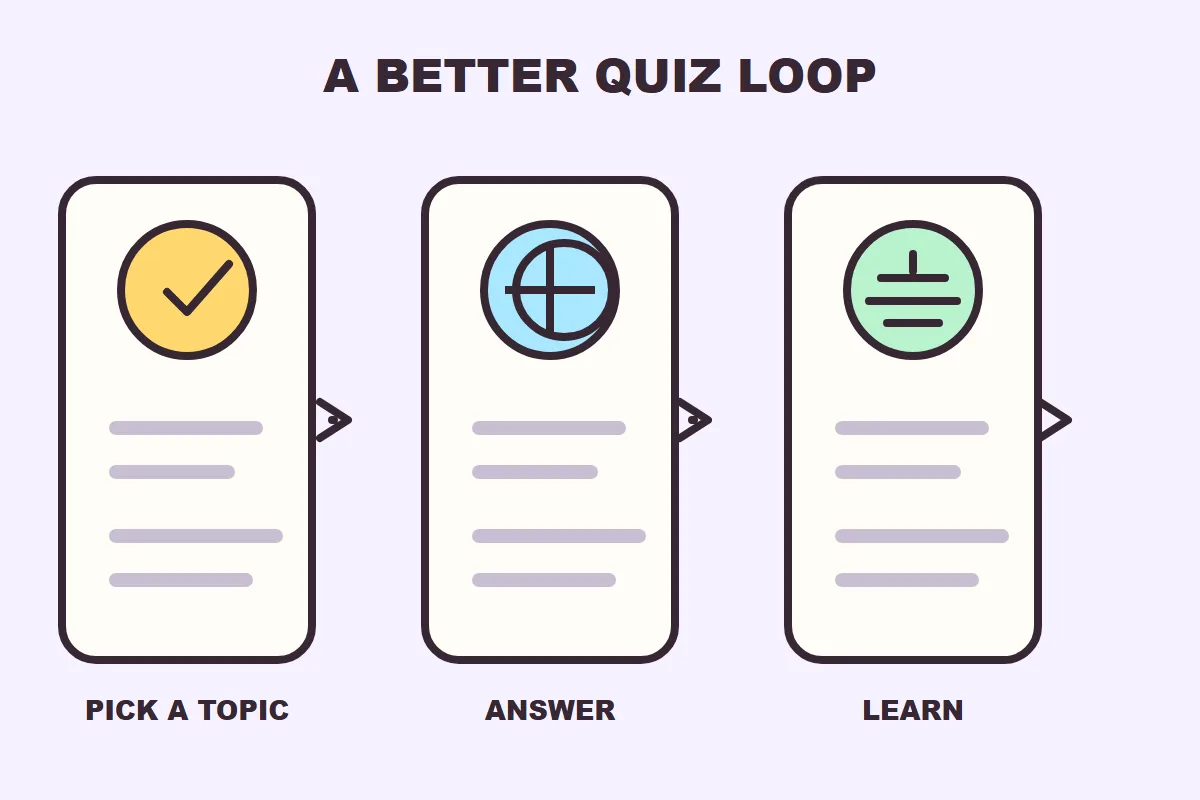
A small amount of structure makes a question bank easier to learn from. Follow these four steps before you start a new round.
1
Pick a scope
Choose one group for focused practice or mix all five when you want a classic trivia round.
2
Hide the answers
Read the question aloud or cover the answer line before you commit to a guess.
3
Explain the miss
Check the explanation after every response so the fact has a useful reason attached to it.
4
Change one variable
On the next round, change the topic, difficulty, or question count, but keep the other settings steady.
THE QUESTION BANK
30 general knowledge quiz questions with answers
Questions are grouped by subject so you can run a mixed round or focus on one area. Each answer is followed by a compact explanation rather than a bare answer key.
01
Science and nature
Start with familiar science facts about space, living systems, matter, and the forces around us.
Question 01Easy
Which planet is the largest in our solar system?
Answer: Jupiter
Jupiter is a gas giant and is larger than every other planet in the solar system.
Question 02Easy
Which gas do plants absorb during photosynthesis?
Answer: Carbon dioxide
Plants use carbon dioxide, water, and light energy to make sugars during photosynthesis.
Question 03Easy
What is the process called when liquid water becomes vapor?
Answer: Evaporation
Evaporation happens when molecules at a liquid surface gain enough energy to enter the air.
Question 04Easy
What is the largest organ of the human body?
Answer: The skin
Skin covers the body, helps regulate temperature, and provides a first barrier against the outside world.
Question 05Easy
Which planet is known as the Red Planet?
Answer: Mars
Iron minerals in Martian dust give the planet its familiar reddish appearance.
Question 06Medium
What force pulls objects toward Earth?
Answer: Gravity
Gravity is the attraction between masses, including the pull between Earth and nearby objects.
02
History and culture
These questions connect memorable people, places, works, and turning points across world history and the arts.
Question 01Easy
In which country did the Renaissance begin?
Answer: Italy
The Renaissance grew in Italian city-states such as Florence before spreading across Europe.
Question 02Easy
Who wrote Romeo and Juliet?
Answer: William Shakespeare
Shakespeare wrote the tragedy in the late sixteenth century; it remains one of his best-known plays.
Question 03Easy
Who was the first person to walk on the Moon?
Answer: Neil Armstrong
Armstrong stepped onto the lunar surface during NASA's Apollo 11 mission in 1969.
Question 04Easy
In which country is the ancient city of Petra?
Answer: Jordan
Petra is a historic city in southern Jordan, famous for buildings carved into sandstone cliffs.
Question 05Medium
Who painted the Mona Lisa?
Answer: Leonardo da Vinci
Leonardo da Vinci painted the portrait during the Italian Renaissance; it is displayed at the Louvre.
Question 06Easy
In what year did World War II end?
Answer: 1945
The war ended in 1945 after Germany surrendered in Europe and Japan surrendered later that year.
03
Geography and the world
Use capitals, oceans, landmarks, and regional clues to practise the people-and-places part of general knowledge.
Question 01Easy
What is the capital city of Australia?
Answer: Canberra
Canberra is Australia's national capital, located inland between Sydney and Melbourne.
Question 02Easy
Which is the largest ocean on Earth?
Answer: The Pacific Ocean
The Pacific Ocean covers more area than any other ocean and stretches between Asia and the Americas.
Question 03Easy
On which continent is the Sahara Desert?
Answer: Africa
The Sahara spans much of northern Africa, from the Atlantic coast toward the Red Sea.
Question 04Easy
What is the currency of Japan?
Answer: The yen
The yen is Japan's official currency and is written with the symbol ¥ or the code JPY.
Question 05Easy
Which major river flows through Egypt?
Answer: The Nile
The Nile flows north through Egypt and has supported settlements and farming for thousands of years.
Question 06Easy
Which country has a red maple leaf on its flag?
Answer: Canada
The maple leaf is a central symbol on Canada's red-and-white national flag.
04
Technology and everyday facts
Short questions about computing, numbers, materials, and measurement add variety without relying on changing news.
Question 01Easy
What number base does binary use?
Answer: Base two
Binary represents information with two digits, zero and one, which suit electronic on-and-off states.
Question 02Easy
What does CPU stand for?
Answer: Central processing unit
The CPU executes instructions and coordinates many of the operations a computer performs.
Question 03Easy
What instrument measures temperature?
Answer: A thermometer
A thermometer uses a material or sensor whose measurable property changes with temperature.
Question 04Easy
What does HTML stand for?
Answer: HyperText Markup Language
HTML supplies the structure and meaning of content on a web page.
Question 05Easy
How many sides does a hexagon have?
Answer: Six
The prefix hex- means six, so a hexagon is a polygon with six sides.
Question 06Easy
What compound is commonly called table salt?
Answer: Sodium chloride
Table salt is an ionic compound made from sodium and chlorine in a one-to-one ratio.
05
Language, sport, and culture
Finish with familiar books, music, games, and visual culture questions that work well as a quick-fire round.
Question 01Easy
Who wrote the Harry Potter series?
Answer: J. K. Rowling
J. K. Rowling wrote the seven-book Harry Potter series, first published in the late 1990s.
Question 02Easy
How many rings appear on the Olympic symbol?
Answer: Five
The Olympic symbol has five interlocking rings representing the meeting of the world's continents.
Question 03Medium
What is the only chess piece that can jump over others?
Answer: The knight
A knight moves in an L shape and may leap over pieces on its route.
Question 04Easy
How many strings does a standard violin have?
Answer: Four
A standard violin is tuned across four strings, from the low G to the high E.
Question 05Easy
What color results from mixing blue and yellow paint?
Answer: Green
In traditional pigment mixing, blue and yellow combine to produce a green color.
Question 06Easy
What is the longest bone in the human body?
Answer: The femur
The femur runs through the thigh and is the longest and strongest bone in the body.
AFTER THE ANSWER
Review misses without turning the quiz into a test
A wrong answer is useful when you can name the reason for the miss. Was the fact unfamiliar, did two choices look similar, or did you rush the wording? Mark that reason beside the question, then say the correct idea in your own words. This takes less than a minute and gives the next replay a clear purpose.
For a hosted quiz, keep the explanation short when you reveal the answer. One extra fact settles disputes and helps the table remember the result, but a long lecture changes the pace. Save the deeper context for a review round or a link to the relevant topic guide.
01
Name the source of the miss
Separate a knowledge gap from a rushed read or two similar choices.
02
Say the idea aloud
A one-sentence explanation is easier to remember than a bare word on a score sheet.
03
Replay with a small change
Switch one topic or setting so improvement has a clear comparison point.
QUESTION BANK FAQ
Questions about using a general knowledge question set
How many questions should a general knowledge quiz have?
Ten questions works well for a short round, while twenty to thirty gives a fuller mix. Choose the length that fits your group and attention span.
Are these general knowledge quiz questions suitable for a quiz night?
Yes. They use stable facts across five broad groups, and each answer includes a short explanation for resolving a discussion at the table.
How can I make the questions easier or harder?
Start with the Easy labels for a warm-up, add Medium questions for a challenge, or mix groups so players can use different strengths.
Should I show the answers immediately?
Hide the answer until everyone has guessed. Reveal the answer and explanation together so the result feels like a learning moment, not only a score.
Can I get an interactive version of these questions?
Yes. The free General Knowledge Quiz lets you choose a category, difficulty, and question count, then gives instant feedback and a replayable score.
READY FOR A LIVE SCORE?
Use the list first, then play a fresh round
When you want instant feedback, selectable categories, and a replayable score, open the free browser quiz and let the next mix choose the challenge.