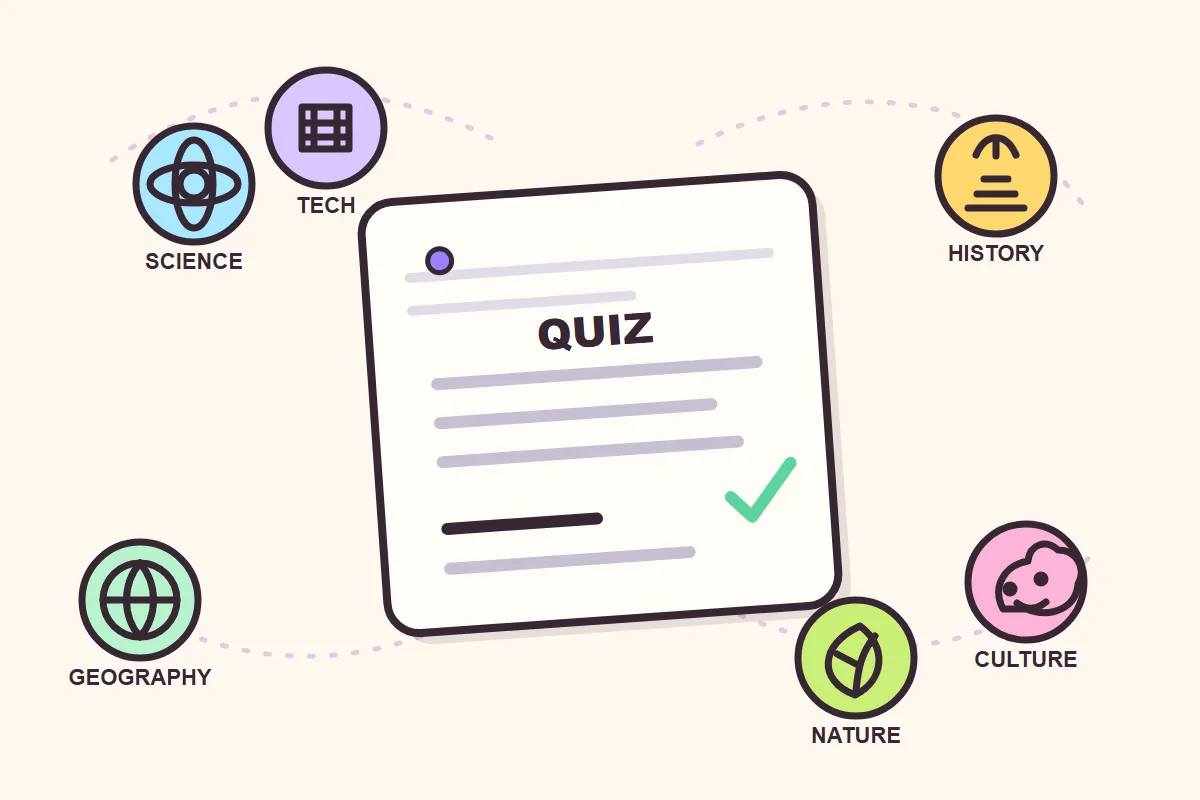
A good general knowledge quiz moves between subjects without making the round feel random. Use this guide to see what each topic covers, choose a comfortable starting point, and then open the free quiz when you are ready to answer.
Six broad subjects · instant answer explanations · no sign-up
The strongest rounds balance familiar facts with one or two questions that make you think.
WHY TOPICS MATTER
Turn a broad quiz into a useful practice session
General knowledge is wide by design. One question may ask about a planet, the next about a capital city, a painting, a technology term, or an animal adaptation. That variety is what makes a general knowledge quiz lively, but it can also make a short score hard to interpret. Looking at the topic mix first gives you a clearer expectation of the round and helps you notice which areas deserve another try.
The directory below is a reading guide rather than a school syllabus. The quiz uses approachable questions, short explanations, and a mix of difficulty. You can choose all topics for a balanced challenge or start with one subject when you want focused practice. After each answer, read the explanation: the point is to connect a fact to its context, not simply to collect a number.
THE TOPIC DIRECTORY
What this general knowledge quiz covers
Each card gives you a plain-language boundary for the subject, an example of the kind of question you may meet, and a small strategy for reasoning when the answer is not immediately obvious.
⚛
Science
Explore everyday science, space, the living world, matter, and the ideas that explain how things work.
Best for
curious learners who enjoy causes and evidence
Example focus
planets, body systems, energy, materials, and famous discoveries
Helpful strategy
Look for the process or relationship in the wording. Eliminate answers that describe an effect instead of the cause.
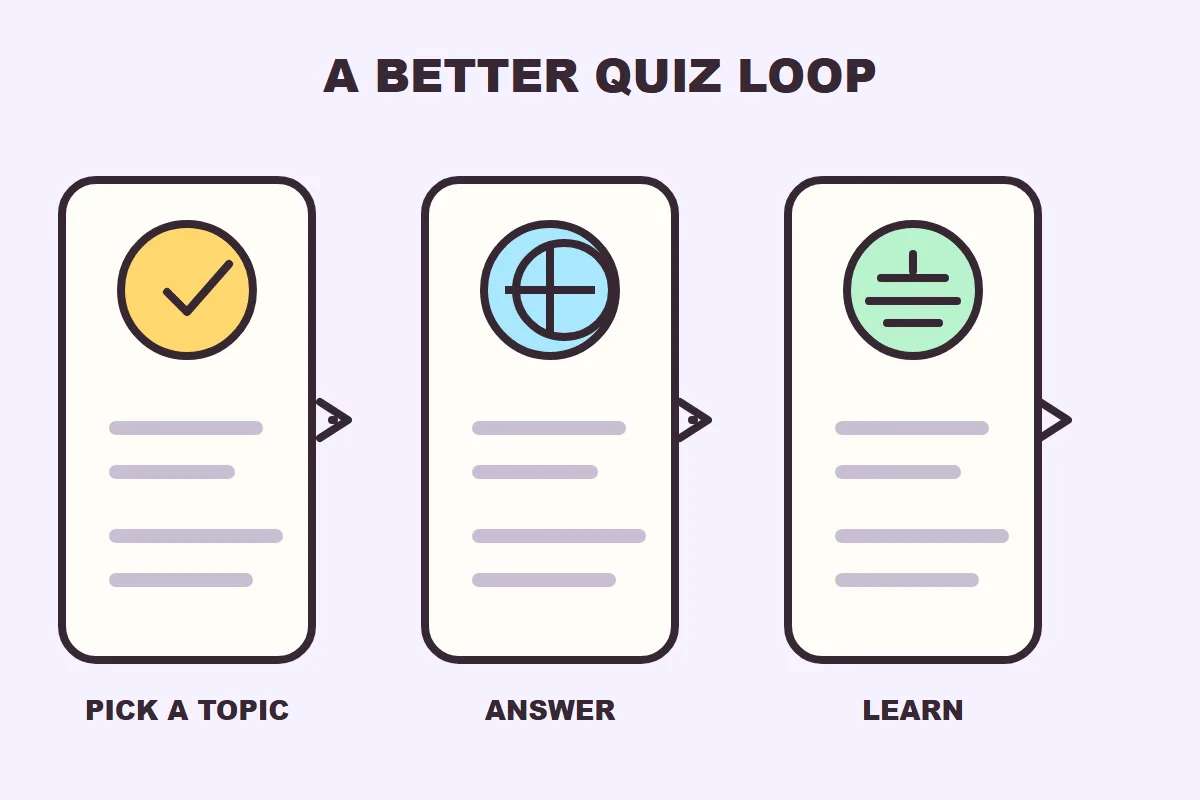
Choose a subject, answer with care, then use the explanation to guide the next round.FROM TOPIC TO TAKEAWAY
How to use a topic guide before you play
You do not need to plan a long study session. A quick choice before the first question is enough to make the round more intentional. The four-step routine below works for a mixed round, a focused category, or a short warm-up with friends.
1
Choose your range
Select all topics for variety or choose one card from the directory when you want a focused set. Set five questions for a quick break, ten for the default round, or fifteen for a longer challenge.
2
Read the clue twice
Before looking at the answer choices, notice the time, place, category, and exact wording. A second read slows down an attractive but imprecise guess.
3
Check the explanation
After you answer, use the feedback to connect the fact with a reason. A short explanation can be more memorable than a bare correct or incorrect label.
4
Replay with purpose
At the end, review the misses and change one setting for the next round. A new category, difficulty, or question count keeps the practice fresh without losing the comparison.
MAKE THE MIX WORK FOR YOU
Pick breadth, focus, or a little of both
Choose all topics when you want a classic trivia feeling and do not mind changing mental gears. A mixed round can reveal connections: a history question may make a geography fact easier, while a science explanation may give you a useful word for a technology question. The variety also keeps practice from becoming a list of facts you already know.
Choose one category when you are learning a new subject, preparing a small group activity, or reviewing misses from an earlier round. Focused play is easier to discuss because the examples share a context. It is also a fair way to compare improvement: keep the topic and question count similar, then see whether the explanations feel more familiar the next time.
01
Use breadth for discovery
Mixed topics expose gaps you may not notice in a specialist quiz. Treat an unfamiliar question as a prompt to learn one useful fact.
02
Match the difficulty to the moment
Mostly easy questions are good for a quick start. Medium or hard settings work better when you want to slow down and reason through clues.
03
Replay with one change
Change only the category, difficulty, or question count on the next round. That makes the result easier to compare and keeps the practice purposeful.
WHY ANSWERS INCLUDE CONTEXT
An answer key should help you remember
A general knowledge quiz with answers is more useful when the answer is paired with a short reason. The explanation confirms the correct choice, clears up a common mix-up, and gives you a detail to carry into another question. For geography, that might mean placing a city in its region. For science, it might name the process behind a result. For culture or history, it can distinguish a familiar name from the role it actually played.
Use the review as a tiny learning loop. Notice the question you missed, say the correct idea in your own words, and decide whether the miss came from memory, wording, or a rushed guess. Then replay later with a different mix. This approach keeps the quiz light enough for a break while still making each round add something to your general knowledge.
01
The answer is shown immediately so you can connect it to the wording you just considered.
02
The explanation stays short enough to keep the experience feeling like a quiz, not a textbook chapter.
03
A missed answer is a useful prompt for one follow-up fact, especially when you can place it in a topic or timeline.
04
Scores use the actual number of questions in the round, so a short or filtered quiz remains easy to read.
QUESTIONS ABOUT QUIZ TOPICS
General knowledge quiz topics FAQ
What topics are included in this general knowledge quiz?
The current topic guide covers science, history, geography, culture and arts, technology, and nature and sport. You can mix them together or choose a focused category from the quiz controls.
Which topic should I choose first?
Choose a familiar topic when you want a confident warm-up. Choose a less familiar one when you want to learn. The mixed setting is a good default when you are unsure because it shows you where your next useful review might be.
Are these general knowledge quiz topics suitable for beginners?
Yes. The quiz mixes approachable facts with a few questions that require careful reasoning. You can select mostly easy questions, read each explanation, and replay without creating an account.
Can I practise one subject instead of taking a mixed quiz?
Yes. Select a category such as science, history, or geography before starting. Focused rounds are useful for learning a new area or revisiting questions you missed earlier.
Does the quiz show answers and explanations?
Yes. After you submit a choice, the quiz identifies the correct answer and gives a short explanation. At the end, the review list lets you revisit the round before playing again.
How long should a general knowledge quiz round take?
A five-question round works as a quick warm-up, while the default ten-question round gives you more variety. A fifteen-question round takes longer and is useful when you want a fuller practice session.
READY TO TRY ONE?
Choose a topic, then let the questions surprise you
Open the browser quiz to choose all topics or focus on one. You will see immediate feedback, a short explanation, and a replayable score at the end of the round.